
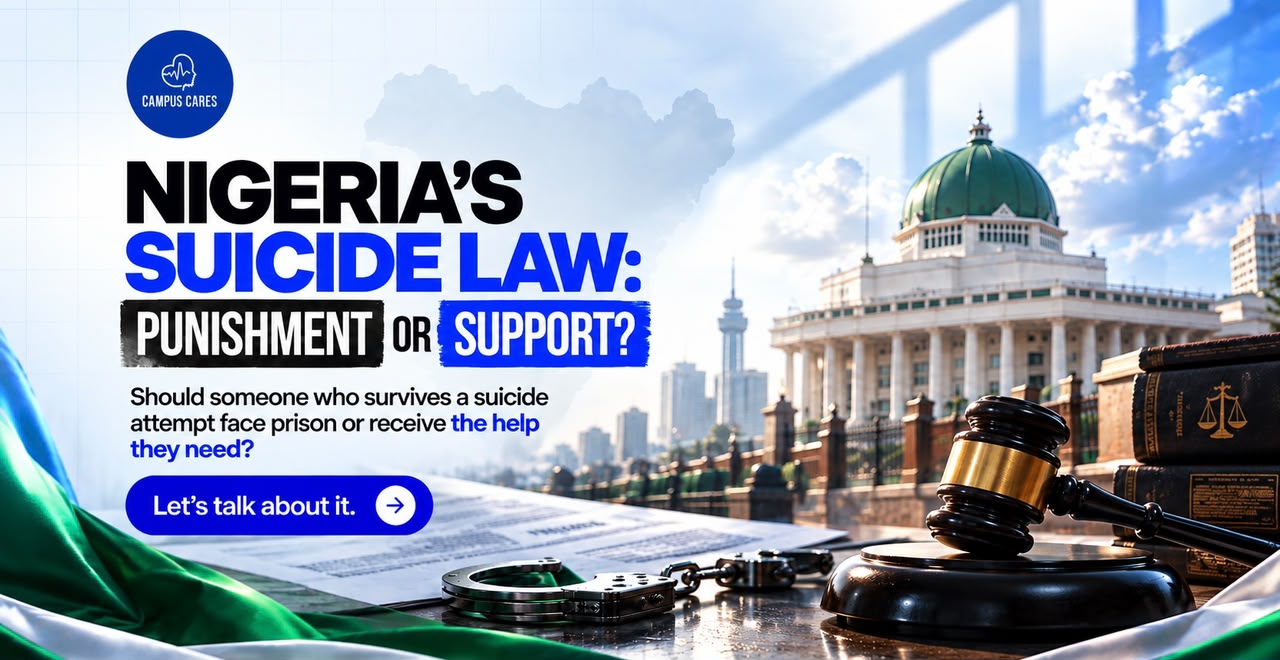
“If you attempt suicide, make sure you die. Anyone who attempts and fails will go to jail.”
These were the words of Nigeria’s Senate President, Godswill Akpabio, who opposed a bill seeking to decriminalise attempted suicide. On October 13, 2026, the bill, sponsored by Senator Asuquo Ekpenyong, representing Cross River South, passed its second reading in the Senate (Premium Times, 2026). Aside from politics and reactions, there is a question we need to sit with. What does this tell someone who is struggling to ask for help?
Nigeria’s debate over decriminalising attempted suicide is also about the kind of response we give people when they are at their most vulnerable.
What Does the Law Say?
For years, Sections 327 of Nigeria’s Criminal Code and 231 of the Penal Code have criminalised attempted suicide, making it punishable by imprisonment (Premium Times, 2026).
Someone who survives a suicide attempt needs urgent medical attention, psychological support, and time to recover, but they may also have to worry about prosecution.
If asking for help feels unsafe, how do we expect people to reach out?
As of October 13, 2026, the bill has passed its second reading but has not yet become law.
There Is More to the Story
Suicidal distress does not have one explanation. It may be connected to depression, financial pressure, grief, relationship difficulties, abuse, loneliness, or several painful experiences happening at once.
Some people struggle quietly for a long time, while others reach a breaking point during a period of intense distress. We can’t always know what someone is experiencing simply by looking at them.
The World Health Organization (WHO) explains that suicide is influenced by complex social, psychological, cultural, and economic factors and that stigma can prevent people from seeking help (WHO, 2023).
This is why we must be careful not to become people who make seeking help more difficult.
Punishment Is Not Prevention
According to the WHO’s 2026 suicide fact sheet, approximately 727,000 people died by suicide globally in 2021. The WHO also notes that many more people make suicide attempts and that the illegality of suicidal behaviour in some countries can contribute to underreporting.
Nigeria faces similar concerns around stigma and incomplete reporting, making it difficult to capture the full picture.
In its 2023 policy brief, the WHO identified decriminalisation as one important step governments can take to strengthen suicide prevention (WHO, 2023). This will not automatically solve the problem, but it means our response should make it easier for people to access car rather than give them another reason to hide their struggles.
What Prevention Looks Like
Decriminalisation is an important step, but it can’t stand alone. Removing a criminal penalty will mean little if someone who needs help can’t access a mental health professional, afford treatment, or find a safe person to talk to.
A humane response should include immediate medical attention where necessary, professional mental health assessment, appropriate treatment, safety planning, and follow-up support.
Families and trusted members of the community can also play an important role (provided their involvement is safe and supportive).
Nigeria is not the first country to reconsider these laws. The WHO’s 2023 policy brief documents reforms in countries including Singapore, Guyana, and Pakistan. Their experiences show that legal reform is possible, but changing the law is only part of the work.
Accessible treatment, public awareness, and proper suicide-prevention strategies must follow. Nigeria should learn from these experiences while building a response that reflects the needs of its own people.
People Need Help, Not Punishment
At Campus Cares, we believe that conversations about mental health must leave room for compassion and practical support.
A suicide attempt should never be reduced to a headline, a public argument, or an opportunity to shame someone. We can acknowledge the seriousness of suicidal behaviour without treating the person who survives like a criminal.
As the bill moves through the legislative process, we must ask for more than a change in the law. We must ask for a society where people can access help without stigma and adequate mental health services.
The goal should not simply be to punish people for reaching a breaking point. It should be to help them find a way through it alive.